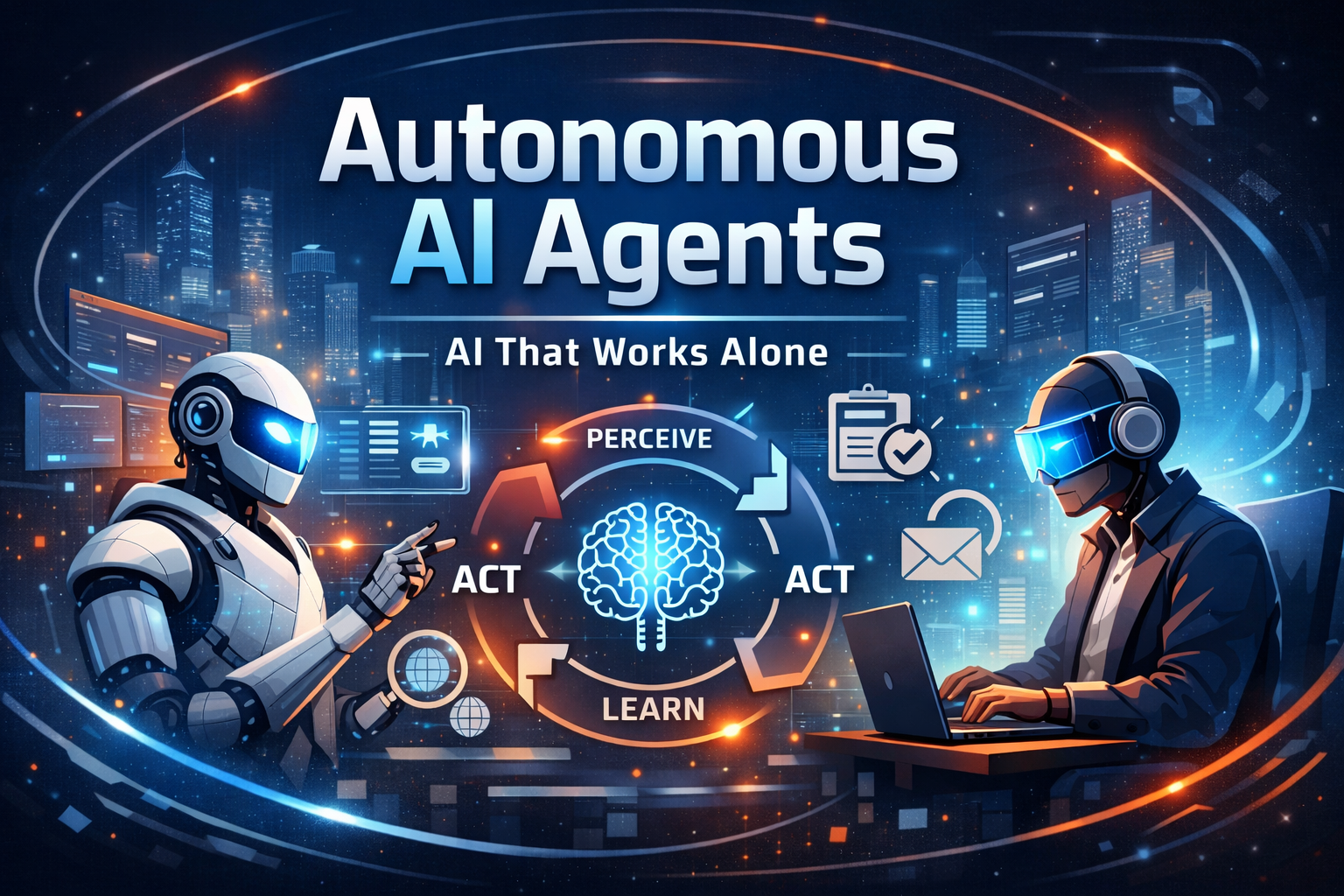
Autonomous AI Agents
What Are Autonomous AI Agents?
Autonomous AI agents are software systems that can plan, decide, act, and learn with minimal human input. Unlike traditional chatbots that respond to prompts, these agents execute end-to-end tasks—from setting goals to completing workflows across apps and services.
Why This Is Trending Now
Three forces have converged:
- Stronger foundation models (reasoning + tool use)
- Reliable API ecosystems (apps, data, actions)
- Lower deployment friction (cloud + orchestration)
Major platforms such as OpenAI and Google are accelerating agent capabilities, pushing them from demos to production.
How AI Agents Work (Simple View)
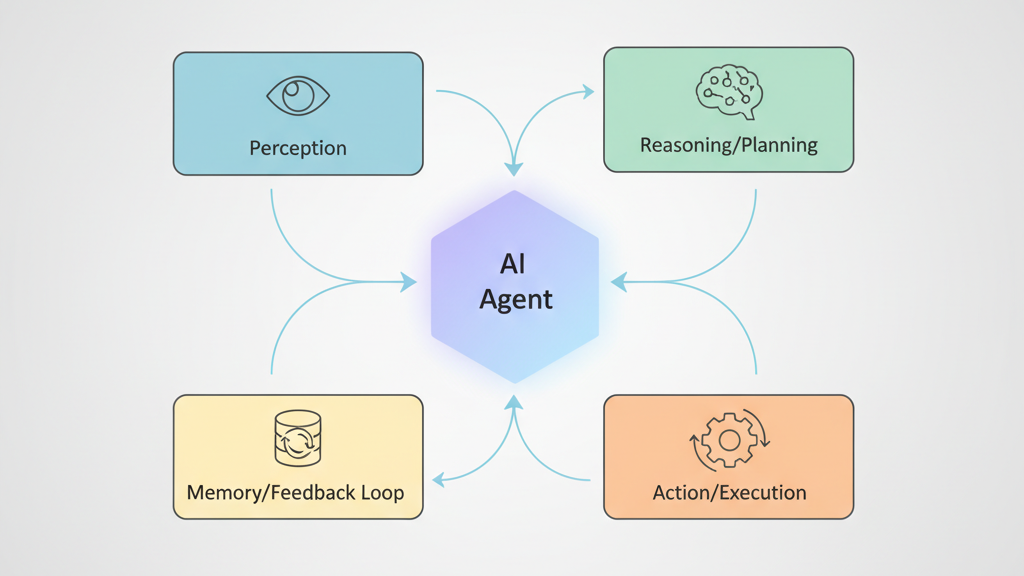
- Perceive: Read inputs (text, files, APIs, sensors)
- Plan: Break goals into steps
- Act: Call tools (code, APIs, browsers)
- Learn: Improve via feedback and memory
This loop enables agents to handle complex, multi-step objectives.
Real-World Use Cases
- Software Development: Code generation, testing, refactoring, deployment
- Business Operations: Automated reporting, CRM updates, invoice handling
- Cybersecurity: Log analysis, anomaly detection, incident response
- Personal Productivity: Research, scheduling, budgeting assistants
Benefits
- Speed: Execute tasks 24/7
- Scale: Handle thousands of workflows simultaneously
- Consistency: Fewer human errors
- Cost Efficiency: Reduce repetitive labor
Challenges & Risks
- Control & Safety: Prevent unintended actions
- Data Privacy: Secure access to sensitive systems
- Reliability: Avoid cascading errors
- Governance: Clear human-in-the-loop checkpoints
What This Means for Developers & Students
Learning to design, supervise, and integrate agents is becoming a core skill. Key areas to focus on:
- Prompt engineering for planning
- Tool integration (APIs, databases)
- Observability (logs, traces)
- Security and permission boundaries
The Road Ahead
Autonomous AI agents are moving toward collaborative multi-agent systems, where specialized agents coordinate like a team—researcher, executor, verifier—unlocking entirely new productivity levels.
Bottom line: AI agents are not just another feature; they represent a paradigm shift in how software gets work done.
nice title make my post uniqe and simple with lot information in 2000 word nearest
AI That Works Alone: A Simple Guide to Autonomous AI Agents (2026)
4
Introduction: A New Kind of Technology Is Here
Technology usually helps humans work faster. Autonomous AI agents are different—they work on behalf of humans. Instead of asking software to do one small thing at a time, we can now give AI a goal, and it figures out the steps, uses tools, checks results, and completes the task by itself.
This is why autonomous AI agents are one of the most important and trending technologies in 2026. They are already changing how software is built, how businesses operate, and how individuals manage daily work.
This article explains autonomous AI agents in simple language, with deep information, real examples, benefits, risks, and what the future looks like.
What Are Autonomous AI Agents?
An autonomous AI agent is a software system that can think, decide, and act independently to achieve a goal.
Traditional software:
- Waits for instructions
- Performs fixed actions
- Stops when the task ends
Autonomous AI agents:
- Understand goals
- Plan steps
- Use tools and APIs
- Adapt to changes
- Continue working until the goal is achieved
In short:
You tell the agent what you want, not how to do it.
How Autonomous AI Is Different from Chatbots
Most people know AI through chatbots. But agents go far beyond chat.
| Feature | Chatbot | Autonomous AI Agent |
|---|---|---|
| Responds to prompts | Yes | Yes |
| Plans tasks | No | Yes |
| Uses tools automatically | Limited | Extensive |
| Works without supervision | No | Yes |
| Can manage long workflows | No | Yes |
A chatbot answers questions.
An AI agent gets work done.
Why Autonomous AI Agents Are Trending Now
This technology did not suddenly appear. It became possible due to three major advancements:
1. Powerful AI Models
Modern large language models can:
- Reason step by step
- Understand context
- Generate structured plans
Organizations like OpenAI have pushed AI from basic text prediction into reasoning systems.
2. Tool Access and APIs
AI agents can now:
- Run code
- Call web APIs
- Read and write files
- Control software
This turns AI from a “thinking system” into a doing system.
3. Cheap Computing and Cloud Platforms
Cloud services by companies like Google and Microsoft make it affordable to deploy agents at scale.
How Autonomous AI Agents Work (Simple Explanation)
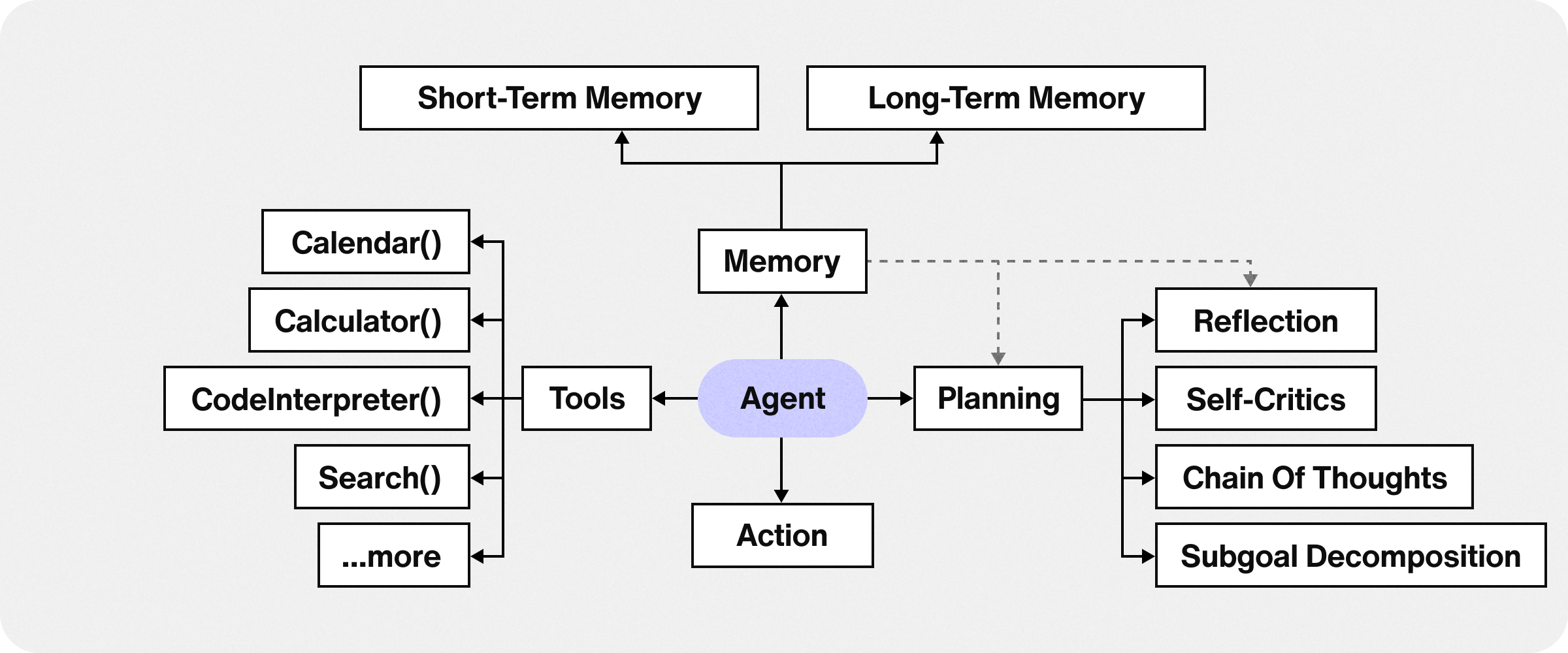
Most autonomous AI agents follow a four-step loop:
1. Perception
The agent collects information from:
- User instructions
- Databases
- Websites
- Sensors or logs
2. Planning
The agent breaks a goal into smaller tasks.
Example goal:
“Create a weekly sales report”
Agent plan:
- Fetch sales data
- Clean the data
- Analyze trends
- Generate charts
- Write a summary
- Send email
3. Action
The agent executes steps by:
- Calling APIs
- Running code
- Using software tools
- Writing files
4. Learning and Feedback
The agent checks results:
- Did the task succeed?
- Is correction needed?
This loop continues until the goal is completed.
Types of Autonomous AI Agents
1. Single-Task Agents
Designed for one purpose:
- Email sorting
- Log monitoring
- Code testing
Simple, fast, and reliable.
2. Multi-Purpose Agents
Can handle many tasks:
- Research
- Writing
- Scheduling
- Analysis
Often used in productivity tools.
3. Multi-Agent Systems
A team of agents with different roles:
- Planner agent
- Executor agent
- Reviewer agent
They collaborate like a human team.
Real-World Use Cases
1. Software Development
AI agents can:
- Generate code
- Fix bugs
- Write tests
- Deploy applications
Developers now supervise agents instead of writing everything manually.
2. Business Operations
Companies use agents to:
- Handle invoices
- Update CRM systems
- Generate reports
- Answer customer queries
This reduces manual workload dramatically.
3. Cybersecurity
AI agents monitor systems 24/7:
- Analyze logs
- Detect anomalies
- Respond to threats
- Isolate compromised systems
This is critical as cyberattacks grow in complexity.
4. Education and Learning
AI agents help students by:
- Creating study plans
- Explaining topics
- Generating practice tests
- Tracking progress
Learning becomes personalized and adaptive.
5. Personal Productivity
For individuals, agents can:
- Manage tasks
- Organize files
- Research topics
- Plan schedules
An AI agent becomes a personal digital worker.
Key Benefits of Autonomous AI Agents
1. Massive Time Savings
Agents work continuously without breaks.
2. Scalability
One agent can be copied thousands of times.
3. Reduced Human Error
Consistent execution avoids mistakes.
4. Cost Efficiency
Less repetitive labor lowers operational costs.
5. Faster Decision-Making
Agents analyze large datasets instantly.
Risks and Challenges
Despite their power, autonomous AI agents introduce serious challenges.
1. Loss of Control
Poorly designed agents may:
- Execute wrong actions
- Delete data
- Trigger unwanted operations
Human supervision is essential.
2. Security and Privacy
Agents need access to:
- Sensitive files
- APIs
- Credentials
This increases security risks.
3. Hallucinations and Errors
AI can still:
- Make incorrect assumptions
- Generate flawed plans
Verification layers are required.
4. Ethical Concerns
Questions arise:
- Who is responsible for agent actions?
- Should agents replace human jobs?
These issues are still being debated globally.
Human-in-the-Loop: The Safety Solution
Most experts agree that fully independent AI is risky.
The best approach is:
- AI executes tasks
- Humans approve critical actions
- Logs and audits track every step
This balance provides efficiency without losing control.
Skills Developers Should Learn
For students and developers, AI agents are a career opportunity.
Key skills include:
- Prompt and goal design
- API integration
- Workflow orchestration
- Security permissions
- Monitoring and logging
The future developer will manage AI workers, not just write code.
How Autonomous AI Will Shape the Future
Short Term (1–2 Years)
- AI agents assist professionals
- Human approval remains mandatory
Medium Term (3–5 Years)
- Multi-agent collaboration
- Higher autonomy with safeguards
Long Term (Beyond 5 Years)
- AI agents manage entire systems
- Humans focus on strategy and creativity